A lot of people are curious about our plans to come home. And we finally have some details which will surprise most of you. As the title eludes to, one of us will be staying here for a while longer. The decision was hard but the opportunity is too hard to pass up. So, I (Jim) will be coming home March 8th and Rachel will be staying here until June. The main reason for the decision is the school really needs her to stay and finish the school year. They are offering her housing near the school and all of her new friends live nearby, so she has a great support group here. It also gives us another opportunity to travel again in Asia this summer.
Sorry the posts have been scarce lately. I still have some more pictures to post from Tibet and another city we visited. Stay tuned, that is my goal for this week...
Monday, February 23, 2009


Friday, January 16, 2009
Lhasa - Tibet Part 1

Our next stop on our vacation was Lhasa, Tibet. Even though Tibet is part of mainland China the Chinese government keeps a careful watch of who enters or leaves Tibet. When we booked our trip we had to submit copies of our passports and work visas. The tour company then arranged to get us a permit to enter Lhasa. This is the reason why we went to Chengdu first. It is one of the entry points into Tibet.
Our first day in Lhasa was spent in the hotel, acclimating to the altitude. Lhasa elevation is about 3650m (11,975ft or 2.25mi). Everything we read about Lhasa told us that we will need a day to get adjusted to the altitude. We definitely needed it. I think we both experienced a little of every symptom from altitude sickness. But later that evening we started feeling better and even took a walk to the local convenience store.
The next morning we headed to our first historic site in Lhasa, The Potala Palace. Construction was started by the fifth Dalai Lama, Lozang Gyatso, in 1645. If you are wondering,(we did) the current Dalai Lama is the 14th. It is about 13 stories tall contains 1000 rooms, 10,000 shrines and about 200,000 statues. The Potala Palace was used as the central seat of government and as the winter palace by the Dalai Lama up until the Tibetan uprising against the Chinese in 1959. Since then, China has turned the palace into a museum. But as we toured the palace you still got a strong sense of it as a religious shrine. Monks still roam the halls and pilgrims still make offerings every chance they can.

After all the hiking and climbing at the Potala Palace we were starving. We then headed to place called Lhasa Kitchen for lunch. It was really nice, with English menus and English speaking staff. And the hot chocolate was the perfect way to warm up.
Our next stop was the Jokhang Temple on Barkhor Square. It is the first Buddhist temple built in Tibet during the reign of King Songsten Gampo between 605 and 650. It was to celebrate his marriage with a Tang Dynasty, Chinese princess named Wencheng, who was Buddhist. The name Jokhang means the 'House of the Buddha'.

Surrounding Jokhang Temple is a circular street named Barkhor Street. And it is the place to be if you want to do some shopping. It is said that after the temple was built, due to its magnificence, it quickly attracted thousands of Buddhist pilgrims. A path around the temple was created by the pilgrims which has become the path known as Barkhor Street. Even today, pilgrims follow the same path walking around the temple in a clockwise direction, many with the prayer wheels. There was an added benefit to everyone walking in the same direction, it made it easy to negotiate pedestrian traffic. What a concept.
As usual, just click on the photos to see the rest.
Sunday, January 11, 2009
Chengdu (where the Panda reserve is located)

Here is the first of many posts for our recent Christmas/New Years' vacation. It was filled with great and unusual food, icy road conditions and crazy taxi drivers among other things. Overall we had a great time. Our first stop on this adventure was Chengdu, near the center of China. It was our gateway into Tibet because visitors have to obtain a special permit to visit the area. We used an agency this time so they arranged everything for us. The name might sound familiar to some, as this was the location of the major earthquake that hit China earlier this year. In fact, the panda reserve that we wanted to visit was partially destroyed so our tour included a different panda reserve. We were still able to see the pandas up close and was able to visit the baby panda area. Unfortunately we were not able to take any photos of the them but I assure you they are very cuddly and playful. All the pandas we did manage to take pictures of were over a year old.
We spent a day and half in Chengdu with very little planned on the agenda. One evening we decided to walk around and see what kind of restaurants we could find. We popped into a couple of them and after looking at the menu (which we couldn't read in Chinese) we decided to head back towards the hotel. Soon we came across something promising. I don't remember the exact name but Steak was part of it. At this point we were both starving and decided to give it a try. Another factor that contributed to us going there was that the place was packed, and if a place scores well with the locals, then it might be worth trying. The menu was in English, the waiter could speak a little and the prices were really cheap. Rachel and I joked about the prices and little did we know, it does make a difference. So with a mix of our broken Chinese and pointing, we ordered what looked like steak and eggs.
After a few minutes our dinners arrived still sizzling on the iron plate with a cover. The server waits for us to hold up our napkins so the oil doesn't splatter all over us, then he removes the cover. Steam rises and reveals a steak, a fried egg and potatoes. It looks great. So we start cutting into the steak and find out why this steak costs about $6 USD. About 80% of it was just fat. What little meat you could find was scattered throughout. We both agreed that it was the worst steak ever. No pictures were taken of this meal...
Well, we hope you enjoy the photos of my favorite animal, the panda. Click on the photo to see the rest.
Friday, December 19, 2008
Christmas Vacation
So it's finally here! Christmas Vacation, and we are taking full advantage of the situation! We leave tomorrow morning to go to Chengdu, Tibet and Harbin. Pretty much we are covering the entire width of China. We will return to Shanghai on the afternoon of January 1, 2009.
A special thank you to my dear friend Valerie for the best Christmas present ever... another post will follow later about that with pictures.
If we have access to high-speed internet at our hotels, we are going to try to use Skype to contact friends and family. But there is a big emphasis on the 'if' at the beginning of that sentence.
Merry Christmas and Happy New Year to everyone!!
Love, Jim & Rachel
A special thank you to my dear friend Valerie for the best Christmas present ever... another post will follow later about that with pictures.
If we have access to high-speed internet at our hotels, we are going to try to use Skype to contact friends and family. But there is a big emphasis on the 'if' at the beginning of that sentence.
Merry Christmas and Happy New Year to everyone!!
Love, Jim & Rachel
Wednesday, December 17, 2008
Falling into a new routine
We have settled into a routine of life since we are both working now. I had a funny experience the other day that is sort of the result of the monotonic pattern our lives have taken.
No one, not even the locals, trust the tap water in China, so almost everyone uses 5 gallon bottles. The only thing you can use the tap for is washing clothes, dishes and to shower. Everythng else you use bottled water for, even when you rinse your mouth after you brush your teeth. At our work places, you won't find water fountains that would be common in the states, but you have bottled water stations around almost every corner.
Since we have to use the 5 gallon bottles, we're never wasteful in our usage. The only problem is that we use more than 1 bottle of water per week, usually 1.5. So we don't have to worry about running short we keep three 5G water bottles at any time. We go to our apartment clubhouse (the management office) to order, pay for and set up delivery of the bottles.
We live in a large apartment complex. Speciffically we live at 1599 Ding Xiang Lu, Building 19, Apartment 1301. Yes, we live on floor 13, but thirteen isn't unlucky in China. Instead, four, 14, 24, etc are, because the word for 4 sounds like death.
To give meaning to this address let me say that there are at least 30 buildings in the complex, which each has 26 stories, and each floor in a building has 2 or 4 apartments per floor. I would estimate that about 1/6 of the buildings have 2-story apartments. At this point, the math teacher in me wants everyone to compute the minimum and maximum possible number of apartments in our complex. Hahaha...
Since the name of this blog is Shiner to Shanghai, its worth pointing out that there are more people who live in our apartment complex than do in Shiner. I'm not sure what the latest census results are for Lavaca County.... To add to the size of our complex, the developer is now in the process of building Phase II of the complex: it will be at 1399 Ding Xiang Lu and is almost equal in size to Phase I we live in.
So Monday night, after I got home from work I had to go order water bottles, a normal event in my life now. I was told they would be delivered by 7pm, which was more than an hour away. I was walking home from the clubhouse and walked into the building by catching the door from a family that was walking out. I held the elevator for a lady who entered the building behind me, and she was thankful. Once she was on, I tried to use my access card that was still in my wallet to access the other floors of the buiding. It didn't scan, which sometimes happens, so she scanned her card and hit the button for floor 21 and I hit the button for floor 13.
I stepped off the elevator at floor 13, and heard the elevator shut behind me. But it didn't look like our floor. I turned quickly to see what floor the sign by the elevator said, I was on floor 13. There was the sounds of a family resonating in the hallway from one of the apartments, which is typical on our floor. The smell of Chinese food, a normal smell on our floor, filled the air. I checked the sign again, still floor 13, but not our floor.
At this point, I start to think, "What's wrong? I'm in China. I'm in an apartment building. Is there a hole in the space-time continumum? Am I caught in a bad episode of The Twilight Zone? Or is it just that my flux capacitor is broke?"
I went to push the down button for the elevators, which were now on floors 21 and 6. While the one on 21 returned to 13, I waited anxiously, and tried to act suave. I tried to pretend like I was supposed to be there, like I was in control, all the while trying to ignore the thoughts that were racing through my head at an ever increasing rate. This entire act was for no one, as I was alone in the common area. The elevator arrived, I jumped on and hit the button for the ground floor. Once on solid ground I jetted out the front doors to inspect the building number. 26, not 19. I entered one building too soon.
I laughed it off as I continued what should have been my original stroll home. But I looked over my shoulder at the same time to make sure know one else was aware of my mistake. I was still alone, and felt confident that I had hid my own silliness.
The water arrived on schedule Monday night, but I honestly forgot to tell Jim about my time warp incident until Tuesday evening. He got a good laugh out of the situation. He almost made the same mistake once, but was unable to gain entry to building 26, and figured it out at that point. He couldn't beleive how long it took me to figure out what was wrong.
Hope you got a laugh out of it too.
No one, not even the locals, trust the tap water in China, so almost everyone uses 5 gallon bottles. The only thing you can use the tap for is washing clothes, dishes and to shower. Everythng else you use bottled water for, even when you rinse your mouth after you brush your teeth. At our work places, you won't find water fountains that would be common in the states, but you have bottled water stations around almost every corner.
Since we have to use the 5 gallon bottles, we're never wasteful in our usage. The only problem is that we use more than 1 bottle of water per week, usually 1.5. So we don't have to worry about running short we keep three 5G water bottles at any time. We go to our apartment clubhouse (the management office) to order, pay for and set up delivery of the bottles.
We live in a large apartment complex. Speciffically we live at 1599 Ding Xiang Lu, Building 19, Apartment 1301. Yes, we live on floor 13, but thirteen isn't unlucky in China. Instead, four, 14, 24, etc are, because the word for 4 sounds like death.
To give meaning to this address let me say that there are at least 30 buildings in the complex, which each has 26 stories, and each floor in a building has 2 or 4 apartments per floor. I would estimate that about 1/6 of the buildings have 2-story apartments. At this point, the math teacher in me wants everyone to compute the minimum and maximum possible number of apartments in our complex. Hahaha...
Since the name of this blog is Shiner to Shanghai, its worth pointing out that there are more people who live in our apartment complex than do in Shiner. I'm not sure what the latest census results are for Lavaca County.... To add to the size of our complex, the developer is now in the process of building Phase II of the complex: it will be at 1399 Ding Xiang Lu and is almost equal in size to Phase I we live in.
So Monday night, after I got home from work I had to go order water bottles, a normal event in my life now. I was told they would be delivered by 7pm, which was more than an hour away. I was walking home from the clubhouse and walked into the building by catching the door from a family that was walking out. I held the elevator for a lady who entered the building behind me, and she was thankful. Once she was on, I tried to use my access card that was still in my wallet to access the other floors of the buiding. It didn't scan, which sometimes happens, so she scanned her card and hit the button for floor 21 and I hit the button for floor 13.
I stepped off the elevator at floor 13, and heard the elevator shut behind me. But it didn't look like our floor. I turned quickly to see what floor the sign by the elevator said, I was on floor 13. There was the sounds of a family resonating in the hallway from one of the apartments, which is typical on our floor. The smell of Chinese food, a normal smell on our floor, filled the air. I checked the sign again, still floor 13, but not our floor.
At this point, I start to think, "What's wrong? I'm in China. I'm in an apartment building. Is there a hole in the space-time continumum? Am I caught in a bad episode of The Twilight Zone? Or is it just that my flux capacitor is broke?"
I went to push the down button for the elevators, which were now on floors 21 and 6. While the one on 21 returned to 13, I waited anxiously, and tried to act suave. I tried to pretend like I was supposed to be there, like I was in control, all the while trying to ignore the thoughts that were racing through my head at an ever increasing rate. This entire act was for no one, as I was alone in the common area. The elevator arrived, I jumped on and hit the button for the ground floor. Once on solid ground I jetted out the front doors to inspect the building number. 26, not 19. I entered one building too soon.
I laughed it off as I continued what should have been my original stroll home. But I looked over my shoulder at the same time to make sure know one else was aware of my mistake. I was still alone, and felt confident that I had hid my own silliness.
The water arrived on schedule Monday night, but I honestly forgot to tell Jim about my time warp incident until Tuesday evening. He got a good laugh out of the situation. He almost made the same mistake once, but was unable to gain entry to building 26, and figured it out at that point. He couldn't beleive how long it took me to figure out what was wrong.
Hope you got a laugh out of it too.
Taxi Adventure in Xian
I've been meaning to post about this and in the last post, Jim alluded to our taxi adventure in Xian during the first weekend in October.
So we arrived at the Xian airport after our flight was delayed in Beijing, we collected our bags and made our way to the taxi line in front of the airport. We had printed the address of our hotel in Mandarin from the website we used to book all of our travel accomodations to give our taxi driver. (A tip given to us by other expats in the past.) The airport was about 40 km from the town, so we were anticipating somewhat of a drive to get to the center of Xian where we where staying.
As we approached the front of the line, the driver at the front was really excited to see us - which should have been a sign. Like I said, we anticiapted a drive, but the fare of the cab ride should have been considerably less than a similar ride in Shanghai, since Xian is a smaller city compared to the major metropolis of Shanghai. We saw from the sticker on the back window that the initial rate was less than that of Shanghai's; Shanghai's base rate is 11RMB, whereas I think Xian was 8RMB. (I don't recall exact numbers, because I have waited too long to post this... shame on me.)
We loaded our things into the trunk, hopped in the backseat and were headed towards the walled city of Xian. After about 7-10 minutes from my seat behind the driver, I noticed something was wrong with the meter that was supposed to be tracking our fare: the amount the fare was increasing by was not constant. At first we thought it had to do with the rate at which the driver was travelling since most cabs in China accrue fares by distance (when your moving) and time (when you are at a standstill). Maybe the cab's velocity wasn't contant, but we on a highway... and the jumps were still too sporadic for this to be the case. Sometimes the meter would increase by 2RMB, others by 7RMB (almost the base rate!), or some other amount in that range. Jim couldn't see the meter from his seat so, I was calling out the intervals the price was increasing, and we were both trying to deduce a pattern or something logical from the sequence I was muttering.
Then I noticed the meter did not have a fa piao printing from it. A fa piao is an official government issued Chinese receipt, that are used by all businesses in China; they are also used by the government to collect business taxes. Businesses pay the government their taxes and in return are given carbon triplicate booklets for the fa piaos. Taxis are given rolls what can be thought of as 'official adding machine tape' to use in the meter which are used for the fa piao. In Shanghai if a taxi driver cannot produce a fa piao, you are free to leave the taxi without paying.
So at this point in the story, we are on a highway somewhere in rural China, but near Xian, trying to deduce a pattern for the meter, find a reason as to why there is no fa piao, and figure out what our next step is. We realized that we were at the mercy of this driver until we were closer to Xian.
When we did arrive in a more densely populated area, since Jim's Mandarin is a bit better than mine, he started to tell the driver that something was wrong with the meter. The driver started talking to Jim as if he were a native Chinese language speaker, and kept driving us to our final destination.
Jim told the driver to stop the taxi, and we would get out. The driver pulled over, started to talk to us and kept the meter running, which was now around 100RMB. Jim brought up the issue of the fa piao, and the drive showed us that he had pre-printed fa piaos, similar to what you get in restaurants.
We would have just bailed and taken our stuff, except everything was in the trunk, with our passports - the only form of identification we have in China. Jim kept trying to talk to the guy and I tried to keep my blood pressure low. When the conversation of broken Mandarin wasn't going anywhere, the driver called his 'boss' who spoke English and put him on the phone with Jim.
Jim explained the situation slowly and calmly, and the boss tried to tell us we were almost there and the toll would be no more than 150RMB. (Recall the meter is still running and is now near 110RMB.)
By this time, I had had enough and decided to try something else I had learned from other expats. I pulled out my cell phone and called 110. 110 is the Chinese 911 for problems that require the police's attention. 112 is for fire, 114 for the ambulance; there are others but those are the important ones to know.
Once connected, I asked in Mandarin for someone who spoke English, and I got someone whose English was a tiny bit better, but who quickly reverted to Mandarin. So I just said "Yingyue (English)" into the phone until I got someone did speak English. I briefly and slowly explained the situation, and the man on the other end asked me to put the driver on the phone. (Jim was still on the phone with the boss.) I handed the phone to the driver and heard the police screaming at the driver. I was handed my cell phone back and told the driver was going to drive us to a taxi park and we were to only pay 100 RMB.
Jim handed the driver's phone back to him. Having quickly conversed about the situation, we decided it was best to cut our losses now. At this point I think the driver had been shamed pretty harshly by the police and was happy to end the ordeal as well. Jim paid the 100RMB, collected the fa piao and told me not to exit the taxi until he had gotten all our bags from the trunk.
Jim got the bags, I hopped out and another (legitimate) taxi was pulling up behind us. We got in and rode the rest of the way into Xian and paid another 15RMB.
Moral #1: Be wary of excited taxi drivers.
Moral #2: Always know the number of the police in a foreign country.
So we arrived at the Xian airport after our flight was delayed in Beijing, we collected our bags and made our way to the taxi line in front of the airport. We had printed the address of our hotel in Mandarin from the website we used to book all of our travel accomodations to give our taxi driver. (A tip given to us by other expats in the past.) The airport was about 40 km from the town, so we were anticipating somewhat of a drive to get to the center of Xian where we where staying.
As we approached the front of the line, the driver at the front was really excited to see us - which should have been a sign. Like I said, we anticiapted a drive, but the fare of the cab ride should have been considerably less than a similar ride in Shanghai, since Xian is a smaller city compared to the major metropolis of Shanghai. We saw from the sticker on the back window that the initial rate was less than that of Shanghai's; Shanghai's base rate is 11RMB, whereas I think Xian was 8RMB. (I don't recall exact numbers, because I have waited too long to post this... shame on me.)
We loaded our things into the trunk, hopped in the backseat and were headed towards the walled city of Xian. After about 7-10 minutes from my seat behind the driver, I noticed something was wrong with the meter that was supposed to be tracking our fare: the amount the fare was increasing by was not constant. At first we thought it had to do with the rate at which the driver was travelling since most cabs in China accrue fares by distance (when your moving) and time (when you are at a standstill). Maybe the cab's velocity wasn't contant, but we on a highway... and the jumps were still too sporadic for this to be the case. Sometimes the meter would increase by 2RMB, others by 7RMB (almost the base rate!), or some other amount in that range. Jim couldn't see the meter from his seat so, I was calling out the intervals the price was increasing, and we were both trying to deduce a pattern or something logical from the sequence I was muttering.
Then I noticed the meter did not have a fa piao printing from it. A fa piao is an official government issued Chinese receipt, that are used by all businesses in China; they are also used by the government to collect business taxes. Businesses pay the government their taxes and in return are given carbon triplicate booklets for the fa piaos. Taxis are given rolls what can be thought of as 'official adding machine tape' to use in the meter which are used for the fa piao. In Shanghai if a taxi driver cannot produce a fa piao, you are free to leave the taxi without paying.
So at this point in the story, we are on a highway somewhere in rural China, but near Xian, trying to deduce a pattern for the meter, find a reason as to why there is no fa piao, and figure out what our next step is. We realized that we were at the mercy of this driver until we were closer to Xian.
When we did arrive in a more densely populated area, since Jim's Mandarin is a bit better than mine, he started to tell the driver that something was wrong with the meter. The driver started talking to Jim as if he were a native Chinese language speaker, and kept driving us to our final destination.
Jim told the driver to stop the taxi, and we would get out. The driver pulled over, started to talk to us and kept the meter running, which was now around 100RMB. Jim brought up the issue of the fa piao, and the drive showed us that he had pre-printed fa piaos, similar to what you get in restaurants.
We would have just bailed and taken our stuff, except everything was in the trunk, with our passports - the only form of identification we have in China. Jim kept trying to talk to the guy and I tried to keep my blood pressure low. When the conversation of broken Mandarin wasn't going anywhere, the driver called his 'boss' who spoke English and put him on the phone with Jim.
Jim explained the situation slowly and calmly, and the boss tried to tell us we were almost there and the toll would be no more than 150RMB. (Recall the meter is still running and is now near 110RMB.)
By this time, I had had enough and decided to try something else I had learned from other expats. I pulled out my cell phone and called 110. 110 is the Chinese 911 for problems that require the police's attention. 112 is for fire, 114 for the ambulance; there are others but those are the important ones to know.
Once connected, I asked in Mandarin for someone who spoke English, and I got someone whose English was a tiny bit better, but who quickly reverted to Mandarin. So I just said "Yingyue (English)" into the phone until I got someone did speak English. I briefly and slowly explained the situation, and the man on the other end asked me to put the driver on the phone. (Jim was still on the phone with the boss.) I handed the phone to the driver and heard the police screaming at the driver. I was handed my cell phone back and told the driver was going to drive us to a taxi park and we were to only pay 100 RMB.
Jim handed the driver's phone back to him. Having quickly conversed about the situation, we decided it was best to cut our losses now. At this point I think the driver had been shamed pretty harshly by the police and was happy to end the ordeal as well. Jim paid the 100RMB, collected the fa piao and told me not to exit the taxi until he had gotten all our bags from the trunk.
Jim got the bags, I hopped out and another (legitimate) taxi was pulling up behind us. We got in and rode the rest of the way into Xian and paid another 15RMB.
Moral #1: Be wary of excited taxi drivers.
Moral #2: Always know the number of the police in a foreign country.
Sunday, November 30, 2008
Our Visit to Xi'an

Sorry about the lack of posts lately. To be honest, going through the pictures takes some time and we have just been lazy about posting them. Here are the photos from the last two days of our vacation to Beijing.
For this part of the trip we decided to go to Xi'an (shee-on). This is the home of the famous Terracotta Warriors. We ran into our first problem at the airport. For some reason the flight was delayed. Not sure what the real reason was, but it put us behind about 3-4 hours. So we landed in Xi'an a little after noon and after a crazy taxi ride, we arrived at the hotel. I'll let Rachel blog about the taxi ride. It needs it's own post. After settling into our hotel my first priority was making sure we had time to see the terracotta army so we scheduled to have a personal driver come and pick us up first thing in the morning. Then he could take us straight to the airport after we were done. I wanted to go early to try and avoid the crowds as much as possible. After everything was set we had the rest of the day to ourselves to just explore. First on the list was the Bell Tower and the Drum Tower which happen to be just across the street from where we were staying.
The Bell Tower was built in 1384 by Emperor Zhu Yuanzhang as a way to provide an early warning signal to the town by rival rulers. It also marks the geographical center of the this ancient capital. The wooden tower is the largest and best preserved tower of its kind in China. It is 118 ft. high. It stands on a brick base which is 116ft long and about 30ft high on each side.
The Drum Tower located within walking distance was in 1380 during the reign of Emperor Hongwu of the Ming Dynasty (1368-1644), and was renovated twice in 1699 and 1740 in the Qing Dynasty (1644-1911). The intersting part of the design of the Drum Tower is that it is was built without any nails. The Drum Tower was used three times a day to notify the towns people. The first was at sun rise when the gates to the town would be opened. Next was at sun down to close the gates and the last was at midnight.
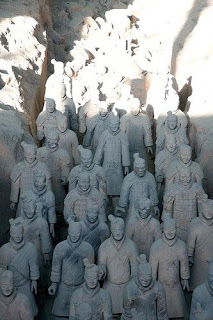
The next day we set out for the Terracotta Warriors at 7 in the morning. The museum opened at 8:30 and I wanted to try to beat as much of the crowd as possible. We got very lucky and arrived early and was able to get some great pictures.
The story of the First Emperor is so fascinating. I had the opportunity to watch a special on T.V. about a month before our trip and learn about the life of the first Emperor and the amazing story behind why he wanted to build the life size army. Here is a more detailed look at his life on Wiki.
Also if you get a chance, watch the Discovery Channel special that I saw called 'The First Emperor: The man who made China'
Here is a short summary of his accomplishments. He is known as the first emperor uniting warring states into a single country which became what we know as China. Soon after, he established a system of weights & measurements, a common currency and a single written language. He also built the first version of the Great Wall and a national road system. As he became older he became more fearful of death. He felt that the people he conquered would come back to haunt him which lead him to order an army which could protect him in the afterlife, the terracotta army. He also wanted immortality, which his alchemists tried to give him, by feeding him mercury. They thought that mercury had special powers so it was mixed into other foods to make it digestible. This however just added to his fear and delusions.
Subscribe to:
Posts (Atom)
